
Blend'n · Pre-seed · Bengaluru
Walk over. They already said yes.
A way to approach someone at an event without risking rejection. GPS-verified. Pseudonymous until you both say yes. Bengaluru first.
Matrix Social Labs · Matryx Social Labs Private Limited
02
Everyone at the event wants to meet someone. Almost nobody walks over.
33%
fear rejection outright when networking; 42% hold back because they feel they're imposing. It is sensitivity to social evaluation, not a skills gap.
Networking-anxiety research
50.3%
of our 2025 survey respondents are uncomfortable starting a conversation with a stranger; 77.6% struggle to form meaningful connections at events they attend.
Our 2025 survey, 75.9% in Bengaluru
43%
of Indians report loneliness; 27% of 19–29-year-olds — against a Gen Z population of 370M+.
India loneliness data
People feel stuck. Organisers can't see what's happening. Nobody can prove anyone met anyone.
03
Blend'n removes the fear of walking over. Everything else is mechanism.
| Piece | What it does |
|---|---|
| GPS check-in at the door | Everyone in the room is actually in the room. No catfish. |
| Pseudonym by default | “Cosmic Panda” until you choose otherwise. Expressing interest costs nothing. |
| Mutual consent opens the conversation | You never approach someone who hasn't already said yes. Rejection risk: zero. |
| The room | A chat about the thing you are both at, right now. A reason to speak at all. |
| The board | “Going alone, looking for somebody to go with.” Nobody walks in alone. |
| Groups Next | Two groups both opt in; nobody approaches alone, nobody is rejected alone. |
This is not a dating app and not an event app. It is the permission layer for the room you're already in.
04· the same evening, from the attendee and the organiser
One night, both sides.
- 1
01
Check in at the door
GPS, against the geofence.
- 2
02
The room
Pseudonymous chat, moderated before delivery.
- 3
03
The roster
Cards name shared interests — never a face or a %.
- 4
04
Both say yes
Conversation opens, identity exchanged.
- 5
05
Organiser live tab
Headcount, mood, alerts — the same night from the other side.
Every step above is running on real devices in closed testing today.
05
We don't sell into the events market. We ride it.
| India | Size | Source |
|---|---|---|
| Events & exhibitions | $6.15B (2026) → $9.04B (2031) | Mordor |
| MICE | $4.59B (2026) → $14.62B (2033), 18% CAGR | Coherent |
| Event-management software | $372–634M (2025) → ~$1.5B (2034), ~16% CAGR | IMARC / Grand View |
| Dating apps | $0.78B (2025) → $1.94B (2034), 28M active users | ReportCubes |
Every event in a Tier-1 city is a room that needs what we do, and the organiser gets us in for free. Revenue comes later from the attendee side and from the one number organisers cannot get anywhere else.
Worst
One city; organiser adoption stalls.
Realistic
Bengaluru, then Mumbai and Delhi. The QR code becomes standard at meetups and club nights.
Best
The room-level social layer for Indian nightlife and meetups, with groups as the retention loop.
06
Pricing is undecided and everything is free today. On purpose.
The organiser dashboard is a distribution channel, not a product — we need a QR code on the screen, not a cheque. Room-level liquidity is the hard cold start, and free is how you get it.
| Hypothesis | Who pays, for what |
|---|---|
| Attendee premium | The only side with clear willingness to pay: priority in the roster, more requests, early access to full events. ₹99–299/month to test. |
| Organiser paid tier, later | Only for the two numbers nobody else has — connections made, and building occupancy against licensed capacity. Everything else on the dashboard is table stakes and KonfHub gives it away. |
| Venue subscriptions | Building occupancy is a safety number; venues with concurrent rooms are the natural buyer. |
Why free, said plainly: if engagement features are commoditised to free in India — KonfHub proves they are — the money in Indian events is in operations and exhibitors, which argues for never charging organisers and using them purely as distribution.
07
Nobody verifies presence.
| Shared context | Verified presence | Real time | Pseudonymous until mutual yes | |
|---|---|---|---|---|
| Tinder / Bumble / Hinge | — | — | — | — |
| Tinder Festival Mode | Badge, up to a month early | — | — | — |
| Happn (180M users) | Crossed paths, 250 m | Proximity, retrospective | — | — |
| Timeleft / 222 / Pie / Bumble Plans | Manufactured dinner or group | A booking, not presence | — | — |
| Whova / Brella / Swapcard / KonfHub | Registration | A login | — | — |
| Blend'n | Yes | Yes — at the door | Yes | Yes |
Tinder's Face Check verifies a photo is a real person; it cannot verify someone will show up. Presence is what the photo was always a proxy for. We skip the proxy.
Happn at 180M users kills the “proximity social always fails” objection. Proximity works when there is a reason to care. An event is the reason.
08· verified on real devices, each guarded by tests
What's built.
| Status | |
|---|---|
| Geo-verified check-in — geofence with extent, buffer and accuracy; never refuses | Built |
| Pseudonymous room, per event; moderation before delivery (keyword, spam, OpenAI) | Built |
| Identity gate — real name and face only on mutual like, accepted request, or opt-in reveal; enforced in one place | Built |
| Roster ranking on structured interests (IDF-weighted), intent, work field, co-attendance; no score ever shown | Built |
| Live sentiment from the room's own chat, classified within a minute | Built |
| Seven live alerts with an owner and acknowledge/resolve; critical ones push to the phone | Built |
| Connection metrics — did anyone meet anyone — suppressed below eight attendees | Built |
| Building occupancy across concurrent events against licensed capacity | Built |
| Peer ratings routed to moderation, never displayed; harassment never averaged | Built |
| Photo checks on every profile photo; age gating; date of birth write-only | Built |
| Group check-in and group-to-group matching — the mixing mechanic | Next |
| Hotspots — time-boxed, reciprocal Go Live at a venue | Next |
The moat is specific: co-attendance is the only ranking signal a person cannot type about themselves — you cannot tick a box to have been somewhere — and no product without verified attendance can compute it.
09· undated until closed testing ends
One city, one room at a time.
Now — closed testing, Bengaluru
TestFlight and Play internal track; organiser dashboard live for the first hosts; the full night driven end to end on real devices.
Phase 1 — the room-level cold start
Organisers put a QR code on the screen and a line in the pre-event email. Tech meetups, club nights, college fests, singles and social nights. Success: share of a room checked in, connections per attendee.
Phase 2 — groups
Group check-in and group-to-group matching. The retention loop the event cannot be — and for many women in India, the precondition for using this at all.
Phase 3 — more cities
Mumbai, Delhi, Hyderabad, on the same motion. Once Bengaluru works, the QR code travels.
Launch follows closed testing.
10
Vision, engineering, brand. Everything on the previous slide was built by these three.

Sagar Kishore
Founder & CEO
Product, UX, community psychology, the founder narrative.
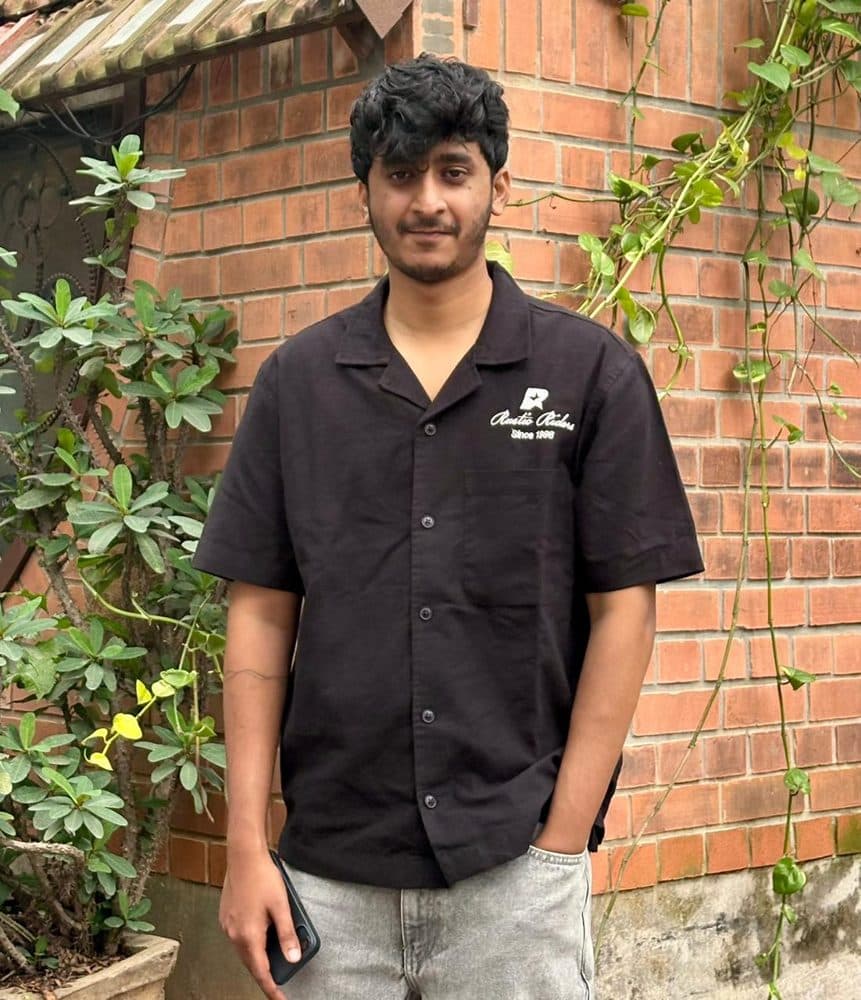
Hemanth Ramesh
Co-founder & CTO
Architecture, data systems, real-time infrastructure.

Likhith Gowda
Co-founder & COO
Brand, storytelling, growth, partnerships.
11· there are no user numbers on this page because there aren't any worth showing yet
Progress, not traction.
Checkable in the repos
- API at release 0.75, a changelog entry per release, 1,100+ automated tests
- App at iOS build 106 / Android build 13 on both stores' testing tracks
- Four production sites; a tester guide; a written testing playbook
- The whole thing runs on a few thousand rupees a month of infrastructure
Open questions we're honest about
- Demand evidence — fifteen people at three events, in their own words. Whatever they say becomes the headline.
- GPS accuracy indoors on mid-range Android in dense venues: the execution risk against the core mechanic.
12· working figures — built bottom-up, adjusted in the room
Raising ₹1 crore, pre-seed.
12–15 months of runway for a team of three in Bengaluru to reach the metrics a seed round asks for. Infrastructure today — Railway, Vercel, EAS, Resend, Tigris, the OpenAI moderation endpoint, Sentry — costs a few thousand rupees a month. Money is not going to servers.
| Share | ₹ | Use of funds, 12 months |
|---|---|---|
| 45% | 45L | Product + team. Two hires — a mobile engineer and a product designer — plus modest founder stipends. Ships groups, hotspots, and moderation as a first-class area. |
| 35% | 35L | Go-to-market, Bengaluru. Organiser partnerships, presence at 25+ recurring events, creator content, referral incentives for the first rooms. |
| 12% | 12L | Operations. Trademark, app-store and legal, accounting, infrastructure as it stops being free. |
| 8% | 8L | Reserve. |
What it buys — outcomes, not dates
The QR code standard at 25 recurring Bengaluru events · groups shipped · the first honest D7/D30 retention curve · connections-per-attendee measured across real rooms · a second city ready to open · the numbers a seed round needs.
13
Why now.
- 1
The IRL turn is 2026's story.
Bumble is teasing a swipe-free future and doubling down on group meetups; Tinder is running in-person events; Timeleft, 222 and Pie sell dinners with strangers. Every one of them manufactures the occasion. We start from the event that already exists.
- 2
Nobody verifies presence.
Festival Mode verifies a badge; Happn a crossed path; Whova a login. We verify the door.
- 3
The organiser gets us into the room for free.
Room-level liquidity is the hard cold start, and a QR code on a screen solves it one night at a time.
- 4
Groups are the retention loop the event can't be.
The event is temporary; the group persists.
- 5
Moderation is the product, not compliance.
Yik Yak died of harassment, not of context. The difference here is a GPS-verified human behind every pseudonym and peer ratings that go to moderation rather than a leaderboard.